.jpg?width=936&height=624&name=Organising%20a%20conference%20(1).jpg)
.jpg?width=68&height=68&name=Brian-Headshot%20(2).jpg)
Deciding how much you’re going to charge delegates to attend your event is a pivotal part of the conference planning process. How high is too high when pricing your conference registration fees?
Setting the right registration fee is one of the most critical decisions for any conference organiser. Armed with best practice guidelines, insights into some tried-and-tested pricing models used by industry experts, plus a few pro tips and our Ex Ordo conference pricing calculator. Too high, and you risk losing delegates; too low, and you may not cover costs. This guide provides practical strategies, pricing models, and tips to balance affordability, revenue, and attendee value.
The key to successful conference pricing lies in understanding your costs, evaluating the market, offering tiered options, and leveraging sponsorships. In this article, we’ll cover the main pricing strategies, cost considerations, and actionable tips to help you set fees that work for your event.

Photo by RDNE Stock project
What you need to know about your projected costs & planned revenue?
Projected costs and planned revenue are the two main factors when it comes to understanding which pricing model to adopt. In other words, the costs you expect to incur by hosting the event, and the revenue you plan to generate from the event, are the two figures you’ll need to hand when it comes to calculating your conference registration fees. If you can anticipate your overall conference costs and estimate your attendance figures based on previous years, it’ll make your life a whole lot easier.
What are your fixed & variable costs that influence pricing your conference?
While there’s no hard rule when it comes to registration fees for research conferences, organisers usually calculate them based on a combination of fixed and variable costs. If you’re not sure you know your fixed costs from your variable ones, check out our post on how to create a conference budget, which includes a detailed breakdown of conference revenue and costs, as well as a free conference budget template. Understanding fixed and variable costs is really important when it comes to working out your conference registration fees.
Five evergreen pricing strategies
1. What is Retail pricing?
The retail pricing strategy relies on ‘projected minimums’. In other words, when pricing your conference registration fees, you’ll first need to understand your fixed and variable costs, and then you can work out the minimum number of delegates you’ll need to attract at a specific price point in order to cover your fixed conference costs.
Essentially, you add up all your conference costs – both fixed and variable – and then you divide the sum by the lowest projected number of delegates. This will give you a good idea of how much you should charge for registration fees.
If you decide to use the retail pricing approach, we’ve created a nifty little tool to help you out. Access our Ex Ordo conference pricing calculator here.
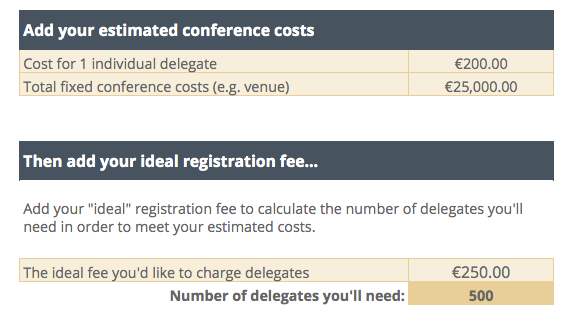
2. What is market pricing?
Essentially the opposite of the retail approach, you begin by setting your registration fees first – based on the market you are targeting and what they can afford – and then you work backwards to build your event within that budget.
One thing to bear in mind when using this particular approach to pricing your conference registration fees, is that market pricing is based on perceived value to delegates. For example, a purely educational event could offer a similar value to delegates whether it’s live or online, but a networking event might not.
Delegates aren’t going to hand over their money simply because you’re hosting a conference. You’ll need to provide them with a certain level of value to secure registration fees – at any price.
3. What is limited-access pricing?
The limited-access pricing approach is a tiered pricing model that creates distinct value at each level. In line with the afore-mentioned market pricing approach when it comes to pricing your conference registration fees, the more you pay, the more you get. Those delegates who can’t afford the higher fees can still attend your conference, while those who can afford to pay more get to enjoy more features and benefits, which helps drive demand.
For example, a basic registration fee might admit a delegate to all your general sessions. This fee should be low enough to attract delegates, but high enough that it reflects the value of your programme content. A mid-level registration fee might provide a delegate with access to all your general sessions, breakout sessions, optional ticketed workshops, and a seat at the keynote luncheon. And a top-tier registration fee might include preferred seating, access to an exclusive break room, and a networking function to rub shoulders with VIPs post-event.
Whilst offering additional value at higher price points helps justify the increased cost, you’d do well to remember that some potential delegates will battle to afford even your basic registration fee. Early-career researchers and researchers from the Global South, for instance, often have difficulty funding international trips to attend conferences. Simply reducing or waiving some registration fees can go a long way towards making your event more inclusive, diverse, equitable, and accessible. You can also consider offering volunteering stints in lieu of registration fees, or bursaries to delegates from under-represented groups.
4. What incentives & penalties to use for pricing your conference?
You can use incentives and penalties to encourage delegates to register within a certain time frame. In fact, most research conference organisers employ cheaper ‘early bird’ registration fees as a promotional tactic to help with covering fixed conference costs early on.
If you’re going to use ‘pricing windows’ when pricing your conference registration fees, just ensure that your potential delegates are aware of this in advance, otherwise you could find late registrants annoyed at having to pony up for additional charges. Most catering suppliers will include a surcharge in their contract for any food orders placed after the final guarantee date. You should explain to late registrants that the additional charge is enforced only to cover these kinds of costs.
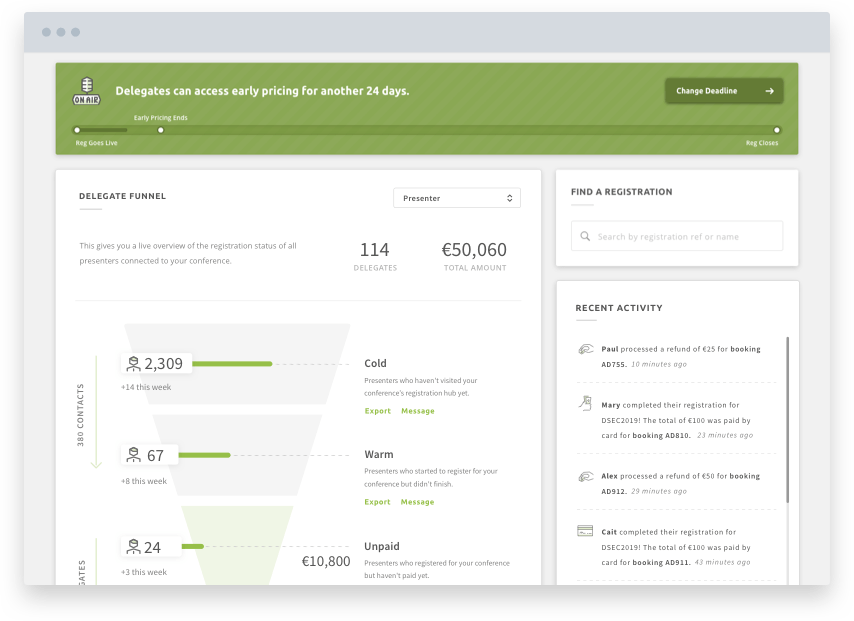
Ex Ordo offers event planners a powerful registration tool designed specifically for research conferences
5. How to manage sponsorship & funding when pricing your conference?
Registration fees alone are unlikely to cover all your conference costs. Conference sponsorship and conference funding are both great ways of bringing in extra revenue. And partnering with the right sponsors can really elevate the perceived value of your event, which in turn will help you attract more delegates.
Identify potential sponsors by drawing up a list of companies that offer products or services related to the theme and/or topics of your conference. Include government organisations, regulatory agencies, and non-profits that deal with similar matters to your theme/topics. Then put together some conference sponsorship packages and approach your potential sponsors. Just make sure that whatever sponsorship opportunities you decide to pursue, they comply with your organisation, region, and industry guidelines.
Check if conference funding is available from any associations or organisations within your field, and investigate conference travel grants from the local tourist board, as the tourism budgets of many countries include funds for conferences with international delegates. Funding pots may have strict deadlines attached, and conference funding bodies may require you to comply with certain criteria. So check if you qualify early on in the planning process.
Monitor & adjust your pricing strategy to achieve the best results when pricing your conference
Registration fee pricing strategies are not one-size-fits-all. It’s important to consider your specific conference objectives, target audience, and market conditions when developing your pricing strategy. You should continuously monitor your registration numbers, feedback from attendees, and the market landscape. Regularly evaluating your pricing strategy and making data-driven adjustments will help you optimise revenue generation and maximise attendance.
Beyond Registration Fees: Unlocking Additional Revenue Streams
While registration fees are the primary source of revenue for most academic conferences, smart organisers know that a sustainable conference relies on a diverse range of income streams. By exploring alternative revenue sources and cost-saving measures, you can potentially lower the final registration fee for your delegates.
Sponsorships and Exhibitors
Sponsorship is a win-win. It provides revenue for your conference while giving companies a platform to engage with your delegates.
-
Tiered Packages: Offer different sponsorship tiers (e.g., Bronze, Silver, Gold, Platinum) with varying levels of benefits, such as logo placement, speaking opportunities, or virtual exhibition space.
-
Targeting Sponsors: Identify companies that have a vested interest in your field. This could be publishers, software companies, or instrument manufacturers.
-
Value Proposition: Clearly articulate the value you offer sponsors, such as access to a highly engaged and specialised academic audience.
Grants and Institutional Funding
Many academic conferences, particularly non-profit or society-run events, can secure grants to help with funding.
-
Grant Applications: Research relevant government or foundation grants that support academic meetings and knowledge dissemination.
-
Institutional Support: Seek funding from your host institution or from the universities of your committee members. They may have a vested interest in your conference's success.
Cost-Saving Measures
Every pound saved is a pound that doesn't need to be covered by registration fees.
-
Negotiate with Vendors: Don't be afraid to negotiate with venues, caterers, and other suppliers. Bundle services where possible to get a better rate.
-
Leverage Technology: A modern conference management platform can significantly reduce administrative costs by automating tasks like abstract management, registration, and communication.
-
Reduce Printing: Cut down on printing costs by using a digital programme and mobile app instead of a traditional printed book. This is also a fantastic way to make your conference more sustainable.
By strategically pursuing these additional revenue streams and implementing smart cost-saving measures, you can build a more financially resilient conference and pass on the savings to your delegates through a more accessible registration fee.
Creating a Detailed Conference Budget
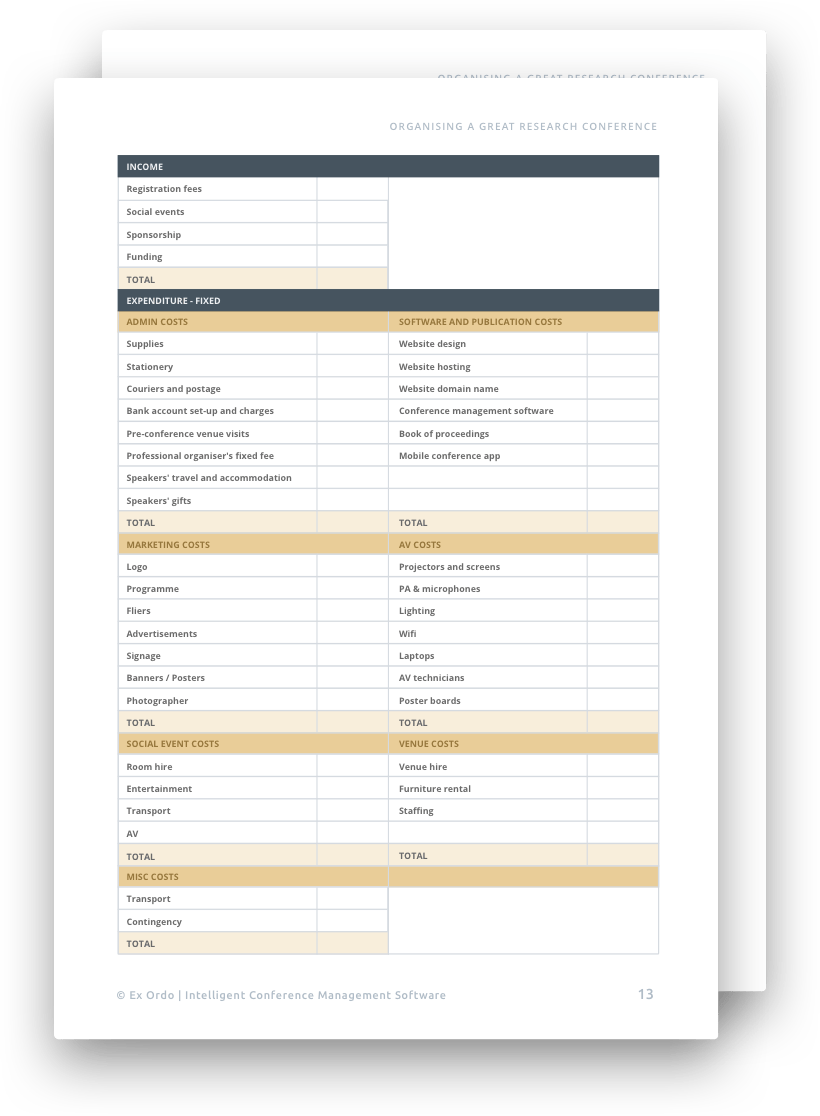
A detailed and centralised conference budget is one of the most crucial steps in successful event planning. It provides a clear overview of all costs and revenue streams, helping you make informed decisions and avoid unexpected financial surprises.
Why a centralised budget matters
Without a centralised system to track expenses, it’s easy for costs to slip through the cracks. A detailed budget allows you to:
-
Identify at which point your event breaks even, runs at a loss, or generates a profit.
-
Make key financial decisions confidently, whether adjusting registration fees, reallocating funds, or seeking sponsorship.
-
Ensure your spending aligns with your financial objectives while delivering an outstanding experience for attendees.
Learning from recent trends
The pandemic reshaped conference budgeting. Organisers often spent less on venues but more on technology, and many adjusted registration fees for online-only events. Some even accepted losses to maintain engagement.
As conferences return to physical formats in 2025, most events now include a strong virtual component to meet attendee expectations. Despite this, profitability remains a major concern, making careful budgeting more important than ever.
Customising your budget
Just as no two conferences are identical, no two budgets are the same. Budgets can range from conservative to highly creative, depending on event goals, format, and audience. A centralised budget ensures every cost, from venue and catering to software and marketing, is accounted for.
Your free conference budget template
We’ve created a free, centralised conference budget template to help organisers plan and manage costs efficiently.
How to use the template:
-
Google Docs / Sheets: File > Make a copy to create an editable version.
-
Microsoft Word / OpenOffice: Download and edit directly.
Note: The template is un-editable by default to prevent accidental changes. By making a copy, you can adapt it to your conference’s unique needs while keeping the structure intact.
To summarise “pricing your conference”
- Before you start the process of pricing your conference registration fees, you need to know your projected costs (both fixed and variable) and your planned revenue.
- You can use the retail pricing strategy which works by adding up all your conference costs – both fixed and variable – and then dividing the sum by the lowest projected number of delegates.
- You can use the market pricing strategy (the opposite of the retail approach), where you begin by setting your registration fees based on the market you are targeting and what they can afford, and then working backwards to build your event within that budget.
- You can use the limited-access pricing strategy to boost the inclusivity, diversity, equity, and accessibility of your event. Whilst also offering a premium experience with added features and benefits for those who can afford it.
- You can use incentives and penalties like cheaper ‘early bird’ registration fees to drive sales. This can cover your fixed conference costs early on.
- Conference sponsorship and conference funding are both great alternative revenue streams, and partnering with the right sponsors can elevate the perceived value of your event.
- Regularly evaluating your pricing strategy and making data-driven adjustments will help you optimise revenue generation and maximise attendance.
- Use our conference budget template to help best manage your conference pricing.
Conclusion / Key Takeaways
Setting conference registration fees is a delicate balance between covering costs, providing value, and ensuring accessibility. By understanding your fixed and variable costs, selecting an appropriate pricing strategy, leveraging tiered options, and incorporating sponsorship, you can create a pricing structure that maximises attendance while remaining financially viable. Using tools like the Ex Ordo pricing calculator makes the process transparent and easier to adjust.
Smart conference pricing isn’t just about numbers—it reflects the value you offer and the inclusivity of your event. Thoughtful pricing enhances attendee satisfaction and supports the long-term success of your conference.



.png?width=1200&height=800&name=People%20at%20Work%20(1).png)